
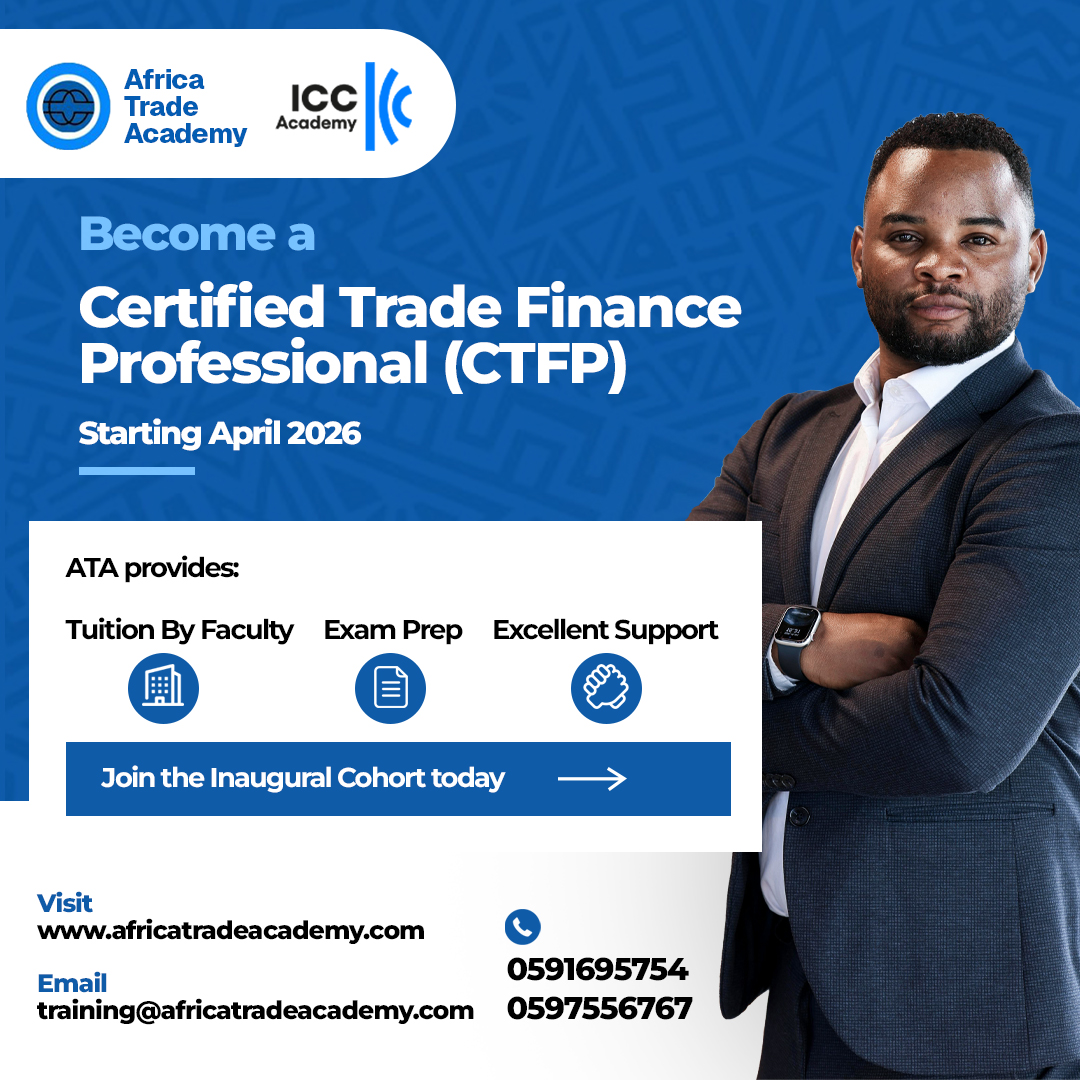
About Course
CTFP designation, by ICC Academy, is a globally recognized certification for professionalism in the trade finance industry. It demonstrates expertise in trade finance products, techniques and compliance issues. The CTFP designation is highly valued in the industry and holders of this certification are recognized for their knowledge and skills in trade finance. Africa Trade Academy is an authorized delivery partner of the ICC Academy taking up the training and exams preparation.
How to earn the CTFP Designation
To obtain the CTFP Designation:
- Meet the eligibility Criteria: The eligibility criteria set by the ICC Academy include 5+ year relevant work experience, education and prior certifications.
- Study the CTFP Body of Knowledge: This covers nine courses in total comprising five core courses and four out of seven elective courses. ATA will provide tuition and exam preparation support to its registered participants.
- Register for the exams: ATA will facilitate participant’s registration for the exams.
- Pass the CTFP exams with required experience: The CTFP exam assesses knowledge and skills in trade finance products, techniques and compliance issues. The final exam can be taken at any time after you have completed the 5 courses. It lasts for 60 minutes and is live proctored via the internet. This means there is someone monitoring your environment via webcam to ensure there is no outside interference and maintain the integrity of the certification. The exam consists of multiple-choice questions. The pass mark is 70%.
Maintain your certification: Applicants must complete professional development (CPD) requirements to maintain the CTFP designation and stay updated with the industry’s development
What The CTFP entails
The CTFP courses comprises of a total of nine courses, made up of five core and seven electives. And out of the seven electives, participants are to choose four.
FIVE CORE COURSES
- Advanced Working Capital- This course covers the processes involved in the asset conversion cycle and the cash conversion cycle, the main factors that drive a company’s working capital such as its days inventory outstanding (DIO), days sales outstanding (DSO) and days payable outstanding (DPO).
- Advanced Documentary Credits- This course provides a detailed review of documentary credited from structuring and issuance documents verification to financing and settlements as well as the importance of a well-managed application process. It analyses document verification and discrepancy management.
- Advanced Guarantees- This course provides knowledge on the issuance of a bank guarantee and the use of counter guarantees and complex transactions, identifying the possibilities for termination of a guarantee and the difference between expiry date and expiry event and identifying the rules that should be applied to a bank guarantee.
- Export Finance- Thiscourseprovides an understanding of the benefits and different types of financing for both short, medium or long term. It also covers export credit and the role of official export credit agencies in international sales and their financing, particularly in developing nations.
- Advanced Supply Chain Finance (SCF) –The course provides an in-depth understanding of how various SCF meet the financing and risk mitigation needs of different events and stages in the supply chain.
ELECTIVE COURSES
Advanced Commodity Finance –This course covers the three types of commodities, their features and the risk involved in financing them as well as commodities trading from a banker’s perspective. Additionally, the course will cover how the major players and trading houses in this sector are shaping the supply chains and their respective roles. It will also cover the function of commodities trading.
Factoring – This objective of the course is to enable the understanding of the fundamentals of factoring, the different types and processes of application. Its operational aspects and how to effectively sell the supply chain finance products and how to prevent risks involved in factoring and mitigate against such risks.
Digital Trade Finance and FinTech- The digital trade finance course will provide an overview of the digital trade ecosystem which includes the advent of FinTech, the legal, regulatory and commercialization involved. This course will introduce a land of fintech, expectations are high for non-bank fintech providers to replace banks with driving efficiencies across the supply chain.
Advanced Standby Letters of Credit- This course will take an in-depthlook at how standby letters of credit work, many of its purposes for which they can be used, the rules and regulation governing them, and problems that can arise around them.
Managing Trade Sales –This course will help you gain an understanding of how to align the organization of your sales team and staffing model to your banks business strategy, target customer markets and sales coverage process. Additionally, it will cover the best practices in trade finance revenue attribution and the complexities of measuring sales performance.
Managing Trade Operation- This course will provide intermediate level banks with an overview of key responsibilities of trade operations management. It provides the range of skills required for long-term success in the position, covering production management of the day-to-day transactions and process management to ensure continued improvement and efficiency of the operational processes.
Managing Trade Products – This course provides an overview of a manager’s role in handling trade finance products and the working model products managers use to develop trade products, a bank’s function in managing an ongoing basis and how they support the development of a new product. It also provides a management philosophy to help build trade product management.
What will you learn
CTFP-certified professionals improve the efficiency and effectiveness of trade finance operations.
The course emphasizes compliance and risk management, reducing the risk of errors and financial losses.
The course provides opportunities to network with other trade finance professionals and stays connected with industry developments.
valuable addition to one’s professional development promotes standardization in trade finance practices.
The course disseminates the best practices and industry standards, contributing to the development of the trade finance profession, Industry Recognition by respected industry associations, banks and corporations worldwide.
Taking the CTFP certification with the Africa Trade Academy, participants will receive excellent tuition support from experienced and accredited facilitators as well as examinations preparation support and excellent customer service.
Who can take this CTFP course
Ideally, participants should have +5 years of trade finance experience to enroll. The CTFP course is targeted at:
- Senior trade finance
- Treasury managers
- Senior corporate banking relationship managers
- Specialists within transaction banking functions
- Senior corporate treasury officers
- Legal and compliance officers within banks
How much is the CTFP Program
The cost for the CTFP courses per participantis GH 20,000 (for Ghanaian participants) USD 2000 (for international participants)
The fee covers the following:
- Assessment Support
- Access to the ICC Academy CTFP plus
- Tuition
- E- learning materials
What is the duration of the course
The CTFP course takes about 50 hours of self-learning to complete. ATA intends to provide a similar number of hours in tuition support and exam preparation.
ATA proposes three course delivery options: subject to enrollment.
Weekdays
- Day Time: Monday to Friday 9:00am-4:00pm (In person)
- Evenings: Monday to Friday 6:00pm-8:00pm (10 weeks) (hybrid)
Weekend:
Saturdays Only 9:00am-3:00pm for 10 weeks (hybrid)
Venue